Saturday, February 24, 2024

February 24, 2024

Greetings Everyone!

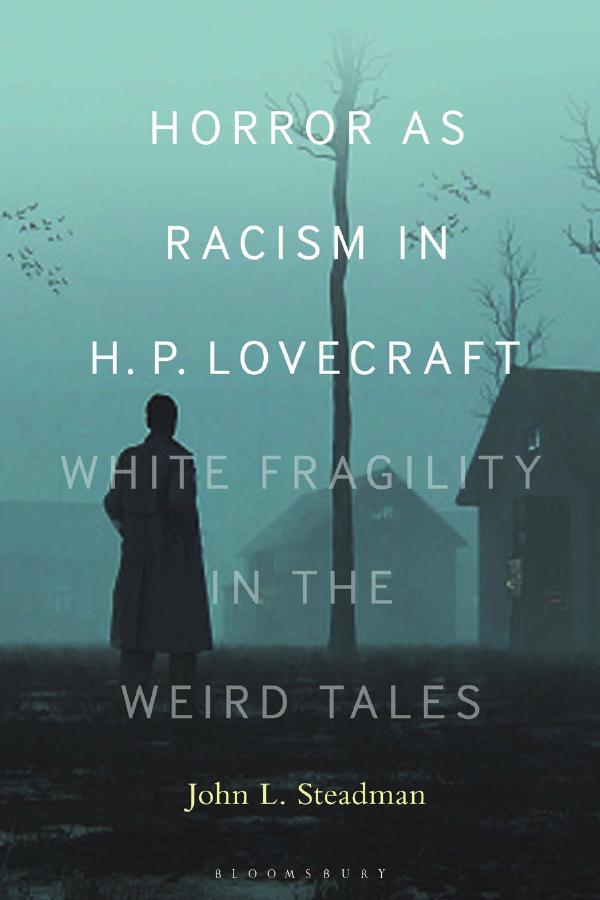
My new book, Horror as Racism in H. P. Lovecraft: White Fragility in the Weird Tales, has just been released by Bloomsbury, the foremost academic publisher in the United States and in the United Kingdom!

I hope that all of you will pick up a copy; you can order it online from the publishers and, of course, from Amazon and other online booksellers around the world.  The book is also available in bookstores here in the states as well as overseas.

https://www.amazon.com/Horror-Racism-H-Lovecraft-Fragility/dp/B0C5CPHCR2

In my previous posting, I examined Lovecraft’s theory of evolution, where he argues that Anglo-Saxons and the other white races are descended from different, more advanced types of apes than the apes that Blacks are descended from; therefore, Blacks and whites are  separate species and Blacks should not be considered as human beings.

In his fictional works, especially in the early works—the tales that I refer to as the hybrid, degenerative monster tales—Lovecraft carries this argument even further.  He  suggests that when it comes to separate, but similar species such as Blacks and whites, there is a built-in genetic barrier that excludes members of the “lower” species from becoming members of the “higher” species.  However, the reverse is not true— members of the higher species can move between the barriers  and de-evolve if they so desire, but this will force them to leave their “humanity” behind.

You can read all about Lovecraft’s theory of evolution and how he uses it to justify his xenophobic political beliefs in Horror as Racism in H. P. Lovecraft!

In my next posting, I will examine one of Lovecraft’s main sources for his views about de-evolution—Robert Louis Stevenson’s famous novel: Dr. Jekyll and Mr. Hyde.

JLS 

Saturday, February 17, 2024

February 17, 2024


 Greetings Everyone!

My new book, Horror as Racism in H. P. Lovecraft: White Fragility in the Weird Tales, has just been released by Bloomsbury, the foremost academic publisher in the United States and in the United Kingdom!

I hope that all of you will pick up a copy; you can order it online from the publishers and, of course, from Amazon and other online booksellers around the world.  The book is also available in bookstores here in the states as well as overseas.

https://www.amazon.com/Horror-Racism-H-Lovecraft-Fragility/dp/B0C5CPHCR2

In two of his earliest poems, “De Triumpho Naturae” (1905) and “On the Creation of Niggers”(1912), Lovecraft upends Darwin’s theory of evolution by proposing a theory of polygenesis, arguing that humans, including the superior types of humans—white Anglo Saxons—evolved from some type of highly developed quadruped, complete with pointed ears and a tail, like its distant cousin the monkey.  However, Blacks evolved from different, lower quadrupeds.  Thus, since white Anglo-Saxons and Blacks are not descended from the same quadrupeds, they are separate species, and therefore, Blacks should not be considered as human beings.

You can read all about Lovecraft’s theory of polygenesis  in Horror as Racism in H. P. Lovecraft, and how Lovecraft uses this theory to insist that Blacks, like monkeys and apes, must be kept separate from humans—they represent, in fact, a threat to the purity of the white race. 

Friday, February 9, 2024

February 9, 2024

Greetings Everyone!

My new book, Horror as Racism in H. P. Lovecraft: White Fragility in the Weird Tales, has just been released by Bloomsbury, the foremost academic publisher in the United States and the United Kingdom!

I hope that all of you will pick up a copy; you can order it online from the publishers and, of course, from Amazon and other online booksellers around the world.  The book is also available in bookstores here in the states as well as overseas.

https://www.amazon.com/Horror-Racism-H-Lovecraft-Fragility/dp/B0C5CPHCR2

Lovecraft lost his privileged lifestyle in his teen years, when he and his mother were forced to move out of their  Providence Rhode Island mansion and live instead in rented rooms located just blocks from their birthright.   This was the most traumatic event in Lovecraft’s life and it activated his white fragility, which had been latent up until this time.  Lovecraft’s racism intensified as well, for he could see that he wasn’t as privileged or superior to the so-called inferior, non-white races as he had believed.

Lovecraft’s loss of his privileged lifestyle, also, triggered a pattern of loss and failure that characterized Lovecraft’s life from that moment onwards: whenever he found himself facing a “crisis,” he would freeze up and be unable to act—thus, whatever he was trying to accomplish ended up in failure.   This pattern is evident not only in the various personal crises that Lovecraft found himself having to face in his adult life, but we see this same pattern of behavior reflected in the lives and careers of the fictional protagonists in his major works.

You can read all about Lovecraft’s personal traumas and the psychological & psychosomatic problems that plagued him  in Horror as Racism in H. P. Lovecraft !   

Thursday, February 1, 2024

February 1, 2024

 Greetings Everyone!

My new book, Horror as Racism in H. P. Lovecraft: White Fragility in the Weird Tales, has just been released by Bloomsbury, the foremost academic publisher in the United States and in the United Kingdom!

I hope that all of you will pick up a copy; you can order it online from the publishers and, of course, from Amazon and other online booksellers around the world.  The book is also available in bookstores here in the states as well as overseas.

https://www.amazon.com/Horror-Racism-H-Lovecraft-Fragility/dp/B0C5CPHCR2

Popular author Matt Ruff, in his Afrofuturistic novel, Lovecraft Country (2016), melds Lovecraftian horror with the horrors of mid-twentieth century racism and links Lovecraft directly to Afrofuturism. 

This novel has been praised for its use of Lovecraft’s subject matter and tropes. But  Horror as Racism in H. P. Lovecraft examines these claims and shows that the Ruff novel isn’t really Lovecraftian at all and, in fact, has little relevance to either Lovecraft or his work. 

John L. Steadman

Thursday, January 25, 2024

January 25, 2024

 Greetings Everyone!

My new book, Horror as Racism in H. P. Lovecraft: White Fragility in the Weird Tales, has just been released by Bloomsbury, the foremost academic publisher in the United States and in the United Kingdom!

I hope that all of you will pick up a copy; you can order it online from the publishers and, of course, from Amazon and other online booksellers around the world.  The book is also available in bookstores here in the states as well as overseas.

https://www.amazon.com/Horror-Racism-H-Lovecraft-Fragility/dp/B0C5CPHCR2

Lovecraft scholar Jeffrey Andrew Weinstock, in his essay “Tekeli-li: Poe, Lovecraft, and the Suspicion of Sameness” (2017) poses these questions: “If the affective power of a text is derived from retrograde sociopolitical points of view, to what extent is the reader who enjoys the works implicated in approving of and disseminating those opinions?  How, in short, should we read—and teach—racist texts?”

After reading Horror as Racism in H. P. Lovecraft, the reader should be in a better position to answer these questions, and though a few readers might find the answers easy, the majority, I think, will find them even more difficult.

John L. Steadman

Wednesday, January 17, 2024

January 18, 2024

Greetings Everyone!

My new book, Horror as Racism in H. P. Lovecraft: White Fragility in the Weird Tales, has just been released by Bloomsbury, the foremost academic publisher in the United States and in the United Kingdom!

I hope that all of you will pick up a copy; you can order it online from the publishers and, of course, from Amazon and other online booksellers around the world.  The book is also available in bookstores here in the states as well as overseas.

https://www.amazon.com/Horror-Racism-H-Lovecraft-Fragility/dp/B0C5CPHCR2

Paul Rolland, Lovecraft scholar and author of The Curious Case of H. P. Lovecraft (2014), writes: “The deficiencies of the man do not...debase the quality of his best work.  If anything, they invest it with a twisted passion that is missing from his more fantastic fiction.”

You may agree with this, or not.  But “twisted passion” is the perfect phrase to describe Lovecraft’s work, especially the racist works.  Horror as Racism in H. P. Lovecraft is, at the very least, an attempt to study and understand exactly how passionate and twisted Lovecraft really was.

So, please check it out!

John L. Steadman 


Wednesday, January 10, 2024

January 11, 2024

 Greetings Everyone!

My new book, Horror as Racism in H. P. Lovecraft: White Fragility in the Weird Tales, has just been released by Bloomsbury, the foremost academic publisher in the United States and in the United Kingdom!

I hope that all of you will pick up a copy; you can order it online from the publishers and, of course, from Amazon and other online booksellers around the world.  The book is also available in bookstores here in the states as well as overseas.

https://www.amazon.com/Horror-Racism-H-Lovecraft-Fragility/dp/B0C5CPHCR2

Horror as Racism in H. P. Lovecraft is the first, book-length study that addresses the topic of Lovecraft’s racism and white privilege.  The book will show for the first time the full extent of Lovecraft’s racism, which ranges from the early works—the hybrid, degenerative monsters tales, as I refer to them, to the later, mature works—the great tales, as they are sometimes called, where Lovecraft’s extra-terrestrial alien races—all of them cosmic slave masters—square off against their own manufactured slave races and, in certain cases, human slaves as well.

The book, in particular, studies how Lovecraft uses his racial hatred creatively by developing racist images and narratives to advocate for his xenophobic political beliefs: that western civilization is in decline due to unrestrained immigration, miscegenation and hybridism; and that slavery is not only endemic, but justifiable among superior civilizations, especially the white, Anglo-Saxon civilizations. 

There is no writer in the English language, and certainly, no writer of comparable magnitude to Lovecraft, who even attempts to do such a thing.  It is, quite literally, an unprecedented phenomenon.

So, please check it out! 

John L. Steadman