Tuesday, October 8, 2024

October 8, 2024

 Greetings Everyone!

It is the second week of October.

 H. P. Lovecraft, surely as much of a patron saint of autumn as Ray Bradbury, personifies October as a “mystic pilgrim” in his poem “October.”

“Mellow-faced with eyes of faery, wistful clad in tinted leaves,

See the brown October tarry by the golden rows of sheaves.

Oak and acorn in his garland, fruit and wineskin in his hands,

Mystic pilgrim from a far land down the road to farther lands.”

This is a bit ironic because Lovecraft didn’t believe in the existence of “farther lands.”  Lovecraft had no love for humans, no hope that human beings could perfect themselves and no faith that higher, spiritual beings exist who care about  us.  He saw only a bleak, frightening cosmos waiting in the future—a cosmos indifferent to us and filled with malevolent entities that seek to insure our destruction.

But this is Lovecraft’s belief and there is no reason why we have to accept it.  

For my part, I believe in the farther lands—the lands of beauty and promise— where we can, if we have enough love, hope and faith, make all of our dreams come true.

JLS 

Tuesday, October 1, 2024

October 2, 2024

Greetings Everyone!

It is the first week of October.

Ray Bradbury, who can be considered as the patron saint of October, describes the last day of the month in his book The Halloween Tree—a book that adults as well as children should read to get into the spirit of this timeless season.

“It was the afternoon of Halloween.

And all the houses shut against a cool wind.

And the town full of cold sunlight.

But suddenly, the day was gone.

Night came out from under each tree and spread.....

Anyone could see that the wind was a special wind this night and the darkness took on a special feel because it was All Hallows’ Eve. Everything seemed cut from soft black velvet or gold or orange velvet.  Smoke panted up out of a thousand chimneys like the plumes of funeral parades.....”

These words seem to be permeated with death. The cold wind; the velvet cerements; the funeral plumes; all of these seem to be a threat.

But Halloween is not about death.  It is about life.

The candle burning in the jack o’ lantern is life and, perhaps, the celebration of the everlasting life to come after death. 

JLS  

Monday, September 30, 2024

September 30, 2024

Greetings Everyone!

October is right around the corner—my  favorite month!

Ray Bradbury describes autumn in his book The October Country  as:

“That country where it is always turning late in the year.  That country where the hills are fog and the rivers are mist; where noons go quickly, dusks and twilights linger, and midnights stay.  That country composed in the main of cellars, sub-cellars, coal-bins, closets, attics, and pantries faced away from the sun.  That country whose people are autumn people, thinking only autumn thoughts.  Whose people passing at night on the empty walks sound like rain....”

In another book, Something Wicked This Way Comes, Bradbury warns us against the autumn people, whom he claims are soulless, evil things that seek to ensnare humans.  But Bradbury is wrong about that.

For there are autumn people who have souls and are not evil; they love autumn and celebrate the death of the year and the renewal that always follows.

JLS


Sunday, September 29, 2024

September 29, 2024

Greetings Everyone!

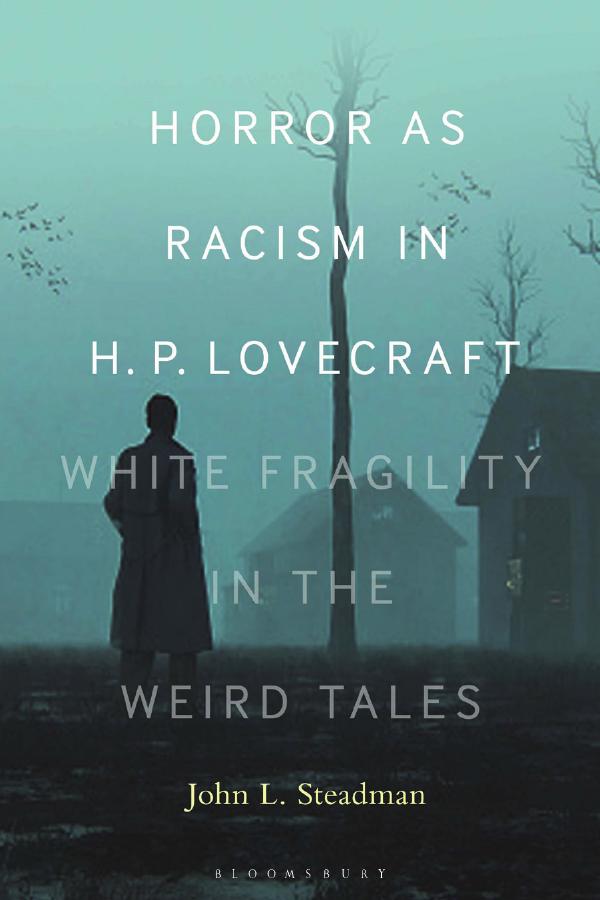
My new book, Horror as Racism in H. P. Lovecraft: White Fragility in the Weird Tales, was recently published by Bloomsbury!  I hope that all of you will pick up a copy!

In my previous posting, I have described Lovecraft’s first racist narrative: the miscegenation narrative.  In his later fiction, Lovecraft develops a second racist narrative—the slave master/slave narrative—which is drawn from Lovecraft’s knowledge of the Atlantic slave trade in colonial times.

Lovecraft  uses this narrative to  promote the practice of slavery.  He holds up the alien astronaut civilizations, the Mi-Go, the Elder Things and the Great Race, all of whom enslaved weaker races, as ideal civilizations — the highest, most advanced civilizations in the cosmos, in fact.  Since these civilizations kept slaves, or so the argument goes, the Anglo Saxon race should feel no compunctions about doing likewise.  

Check out my book for analysis of how Lovecraft uses his slave master/slave narrative in his great, science fiction masterpieces: “The Whisperer in Darkness,” “The Shadow Out of Time,” and  At the Mountains of Madness!

https://www.bloomsbury.com/us/horror-as-racism-in-h-p-lovecraft-9798765107706/

JLS 

Friday, September 20, 2024

September 20, 2024

 Greetings Everyone!

My new book, Horror as Racism in H. P. Lovecraft: White Fragility in the Weird Tales, was recently published by Bloomsbury! I hope that all of you will pick up a copy!

H. P. Lovecraft, in his hybrid, degenerative monster tales, develops his first racist narrative—the miscegenation narrative—which holds that sexual liaisons or intimate, non-sexual associations between members of different races, pose a threat for Anglo Saxon whites. 

In Lovecraft’s view, miscegenation always debases the white partner — male or female — and it can lead to the production of mixed race children, which are, in effect, not only an abomination against natural law, but also a threat to the longevity of the white race and to the survival of western civilization in general.

Check out my book for analysis of how Lovecraft uses his miscegenation narrative in some of his most popular tales: “Herbert West—Reanimator,” “The Lurking Fear,” “The Rats in the Walls” and one of  his greatest tales: “The Shadow Over Innsmouth”!

JLS

https://www.bloomsbury.com/us/horror-as-racism-in-h-p-lovecraft-9798765107706/


Saturday, September 14, 2024

September 14, 2024

Greetings Everyone!

My new book, Horror as Racism in H. P. Lovecraft: White Fragility in the Weird Tales, was recently published by Bloomsbury, the foremost academic publisher in the United States and in the United Kingdom!  I hope that all of you will pick up a copy! 

Lovecraft makes extensive use of racist images in both his early and later works.   These images are drawn from Lovecraft’s observations of members of the non-white race that he most despised and abhorred,  African Americans,  especially as he observed them in the slums of his hometown Providence, Rhode Island and at close quarters during his brief residence in the Red Hook district of New York. 

Lovecraft focuses on the simian and ape-like characteristics that he insisted on seeing in the faces and forms of  the locals and then simply projects these onto his monsters.  He does this in a very conscious and deliberate manner in order to enhance the horror and the repugnance that these creatures inspire in the minds of his readers (or at least, so Lovecraft presumed).

Check out my book for analysis of how Lovecraft uses these images creatively in some of his most popular tales: “Arthur Jermyn,” “Herbert West—Reanimator,” and “The Rats in the Walls”!

https://www.bloomsbury.com/us/horror-as-racism-in-h-p-lovecraft-9798765107706/

JLS


Wednesday, September 4, 2024

September 4, 2024

Greetings Everyone!

My new book, Horror as Racism in H. P. Lovecraft: White Fragility in the Weird Tales, was recently published by Bloomsbury, the foremost academic publisher in the United States and in the United Kingdom! I hope that all of you will pick up a copy!

https://www.bloomsbury.com/us/horror-as-racism-in-h-p-lovecraft-9798765107706/

Lovecraft’s theory of evolution reveals a fear on his part that devolution is a stronger force than evolution.  In my previous posting, I argued that Lovecraft’s theory derives, in part, from  Robert Louis Stevenson’s novel Dr. Jekyll and Mr. Hyde.  Lovecraft was also influenced by Oscar Wilde’s The Picture of  Dorian Gray (1891).

The plot is fairly well-known: Dorian Gray, a beautiful young man, wishes that he could stay young and beautiful while his portrait ages.  He gets his wish; he looks exactly the same for twenty years; the painting, however, grows old and ugly.

Dorian complicates the issue by living a terrible, evil life—he commits murder and he drives men as well as women to suicide.  The portrait reveals Dorian’s inner corruption and it ends up looking even worse than simply an ugly, old man; it looks like a  misshapen, degenerate monster—a half-human, half simian monster.

At the end of the book, Dorian can no longer stand seeing himself like this and he stabs the portrait; then,  the painting  becomes beautiful again, but Dorian dies, and he leaves behind  the ugly, deformed body of his alter ego—much as Dr.  Jekyll in death left behind the hideous body of Mr. Hyde.

The moral of Wilde’s story is the same as Stevenson’s: devolution is stronger than evolution!

JLS